
Gegeven vele intervallen als bereiken en onze positie. We moeten de minimale afstand vinden die we moeten afleggen om een dergelijk punt te bereiken dat alle intervallen in één keer bestrijkt.
Voorbeelden:
Input : Intervals = [(0 7) (2 14) (4 6)] Position = 3 Output : 1 We can reach position 4 by travelling distance 1 at which all intervals will be covered. So answer will be 1 Input : Intervals = [(1 2) (2 3) (3 4)] Position = 2 Output : -1 It is not possible to cover all intervals at once at any point Input : Intervals = [(1 2) (2 3) (1 4)] Position = 2 Output : 0 All Intervals are covered at current position only so no need travel and answer will be 0 All above examples are shown in below diagram.
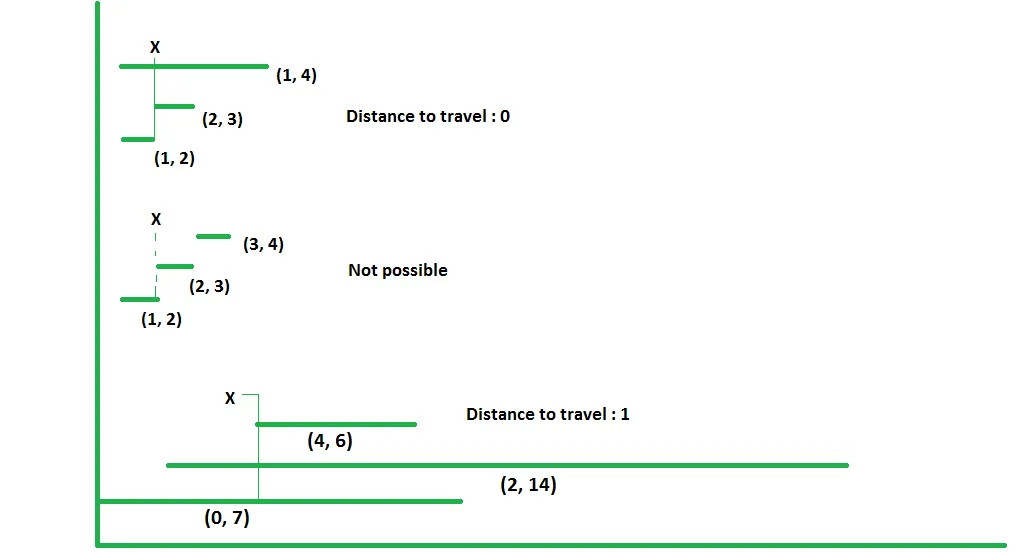
We kunnen dit probleem oplossen door ons alleen op eindpunten te concentreren. Omdat het de vereiste is om alle intervallen te bestrijken door een punt te bereiken, moeten alle intervallen een punt delen voordat er een antwoord bestaat. Zelfs het interval met het meest linkse eindpunt moet overlappen met het interval meest rechtse startpunt.
Eerst vinden we het meest rechtse startpunt en het meest linkse eindpunt van alle intervallen. Vervolgens kunnen we onze positie vergelijken met deze punten om het resultaat te krijgen dat hieronder wordt uitgelegd:
- Als dit meest rechtse startpunt zich rechts van het meest linkse eindpunt bevindt, is het niet mogelijk om alle intervallen tegelijkertijd af te leggen. (zoals in voorbeeld 2)
- Als onze positie zich midden tussen het meest rechtse begin en het meest linkse einde bevindt, is het niet nodig om te reizen en worden alle intervallen alleen gedekt door de huidige positie (zoals in voorbeeld 3)
- Als onze positie op beide punten is overgelaten, moeten we naar het meest rechtse startpunt reizen en als onze positie op beide punten goed is, moeten we naar het meest linkse eindpunt reizen.
Raadpleeg het bovenstaande diagram om deze gevallen te begrijpen. Zoals in het eerste voorbeeld is het meest rechtse begin 4 en het meest linkse einde 6, dus moeten we 4 bereiken vanaf de huidige positie 3 om alle intervallen te dekken.
Zie de onderstaande code voor een beter begrip.
C++// C++ program to find minimum distance to // travel to cover all intervals #include
// Java program to find minimum distance // to travel to cover all intervals import java.util.*; class GFG{ // Structure to store an interval static class Interval { int start end; Interval(int start int end) { this.start = start; this.end = end; } }; // Method returns minimum distance to // travel to cover all intervals static int minDistanceToCoverIntervals(Interval intervals[] int N int x) { int rightMostStart = Integer.MIN_VALUE; int leftMostEnd = Integer.MAX_VALUE; // Looping over all intervals to get // right most start and left most end for(int i = 0; i < N; i++) { if (rightMostStart < intervals[i].start) rightMostStart = intervals[i].start; if (leftMostEnd > intervals[i].end) leftMostEnd = intervals[i].end; } int res; // If rightmost start > leftmost end then // all intervals are not aligned and it // is not possible to cover all of them if (rightMostStart > leftMostEnd) res = -1; // If x is in between rightmoststart and // leftmostend then no need to travel // any distance else if (rightMostStart <= x && x <= leftMostEnd) res = 0; // Choose minimum according to // current position x else res = (x < rightMostStart) ? (rightMostStart - x) : (x - leftMostEnd); return res; } // Driver code public static void main(String[] args) { int x = 3; Interval []intervals = { new Interval(0 7) new Interval(2 14) new Interval(4 6) }; int N = intervals.length; int res = minDistanceToCoverIntervals( intervals N x); if (res == -1) System.out.print('Not Possible to ' + 'cover all intervalsn'); else System.out.print(res + 'n'); } } // This code is contributed by Rajput-Ji
# Python program to find minimum distance to # travel to cover all intervals # Method returns minimum distance to travel # to cover all intervals def minDistanceToCoverIntervals(Intervals N x): rightMostStart = Intervals[0][0] leftMostStart = Intervals[0][1] # looping over all intervals to get right most # start and left most end for curr in Intervals: if rightMostStart < curr[0]: rightMostStart = curr[0] if leftMostStart > curr[1]: leftMostStart = curr[1] # if rightmost start > leftmost end then all # intervals are not aligned and it is not # possible to cover all of them if rightMostStart > leftMostStart: res = -1 # if x is in between rightmoststart and # leftmostend then no need to travel any distance else if rightMostStart <= x and x <= leftMostStart: res = 0 # choose minimum according to current position x else: res = rightMostStart-x if x < rightMostStart else x-leftMostStart return res # Driver code to test above methods Intervals = [[0 7] [2 14] [4 6]] N = len(Intervals) x = 3 res = minDistanceToCoverIntervals(Intervals N x) if res == -1: print('Not Possible to cover all intervals') else: print(res) # This code is contributed by rj13to.
// C# program to find minimum distance // to travel to cover all intervals using System; class GFG{ // Structure to store an interval public class Interval { public int start end; public Interval(int start int end) { this.start = start; this.end = end; } }; // Method returns minimum distance to // travel to cover all intervals static int minDistanceToCoverIntervals( Interval []intervals int N int x) { int rightMostStart = int.MinValue; int leftMostEnd = int.MaxValue; // Looping over all intervals to get // right most start and left most end for(int i = 0; i < N; i++) { if (rightMostStart < intervals[i].start) rightMostStart = intervals[i].start; if (leftMostEnd > intervals[i].end) leftMostEnd = intervals[i].end; } int res; // If rightmost start > leftmost end then // all intervals are not aligned and it // is not possible to cover all of them if (rightMostStart > leftMostEnd) res = -1; // If x is in between rightmoststart and // leftmostend then no need to travel // any distance else if (rightMostStart <= x && x <= leftMostEnd) res = 0; // Choose minimum according to // current position x else res = (x < rightMostStart) ? (rightMostStart - x) : (x - leftMostEnd); return res; } // Driver code public static void Main(String[] args) { int x = 3; Interval []intervals = { new Interval(0 7) new Interval(2 14) new Interval(4 6) }; int N = intervals.Length; int res = minDistanceToCoverIntervals( intervals N x); if (res == -1) Console.Write('Not Possible to ' + 'cover all intervalsn'); else Console.Write(res + 'n'); } } // This code is contributed by shikhasingrajput
<script> // JavaScript program to find minimum distance to // travel to cover all intervals // Method returns minimum distance to travel // to cover all intervals function minDistanceToCoverIntervals(Intervals N x){  let rightMostStart = Intervals[0][0]  let leftMostStart = Intervals[0][1]  // looping over all intervals to get right most  // start and left most end  for(let curr of Intervals){  if(rightMostStart < curr[0])  rightMostStart = curr[0]  if(leftMostStart > curr[1])  leftMostStart = curr[1]  }  let res;  // if rightmost start > leftmost end then all  // intervals are not aligned and it is not  // possible to cover all of them  if(rightMostStart > leftMostStart)  res = -1    // if x is in between rightmoststart and  // leftmostend then no need to travel any distance  else if(rightMostStart <= x && x <= leftMostStart)  res = 0    // choose minimum according to current position x  else  res = (x < rightMostStart)?rightMostStart-x : x-leftMostStart  return res } // Driver code to test above methods let Intervals = [[0 7] [2 14] [4 6]] let N = Intervals.length let x = 3 let res = minDistanceToCoverIntervals(Intervals N x) if(res == -1)  document.write('Not Possible to cover all intervals''
') else  document.write(res) // This code is contributed by shinjanpatra </script>
Uitgang:
1
Tijdcomplexiteit: OP)
Hulpruimte: OP)